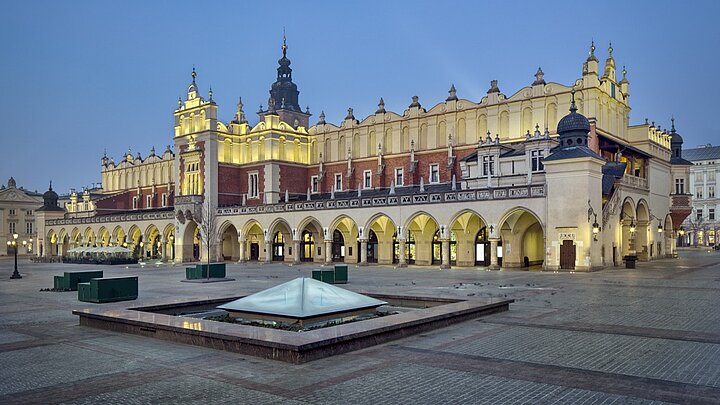
About Krakow
Krakow is the second largest and one of the oldest cities in Poland, located on the Vistula River in Lesser Poland. The city's history dates back to the 7th century. Krakow is a center of academic life, culture, and art. Until March 1596, Krakow was the de facto capital of Poland and the seat of Polish kings.
Describing Krakow's unique character to those who have not yet had the opportunity to visit is no easy task. Its exceptional character stems primarily from the exceptionally rare cultural heritage contained within its city walls. It is home to the headquarters of the Polish Academy of Arts, the Book Institute, the National Science Centre, and the National School of Judiciary and Public Prosecution. The city also boasts numerous institutions of national importance and status, including the National Old Theatre, the National Museum, the National Printing House, the Jagiellonian Library, and the Book Institute. It serves as an administrative, cultural, educational, economic, service, and tourist center. It is a key road and rail hub. It was here, on Wawel Hill, that a castle was built, which became the site of coronations and funerals for kings during the time when Krakow was the capital. In 1364, the first Polish university, today known as Jagiellonian University, was established in Krakow.
The city's image has changed over the centuries. In the Middle Ages, Krakow was a secure, wealthy fortified city surrounded by walls with 55 towers (fragments of the city walls survive to this day). During the Renaissance, Krakow became a center of progressive ideas and culture, attracting the most distinguished humanists, writers, architects, and musicians. Even centuries later, when the city experienced an economic recession during the Modernist period, it is quite likely that the entire Polish artistic elite found refuge in Krakow. Life in the city centers around the Market Square.
Few European cities possess an architectural layout like Krakow's. Looking at the city's rooftops, we see a unique street layout, surrounded by fragments of the preserved city walls. This sight evokes the thrilling image of a medieval fortified city surrounded by defensive walls. The walls were reinforced with 47 towers and had a total length of 3 km. Eight main gates led into the city, only one of which remains. The walls not only protected its citizens but also became a priceless architectural gem. The medieval defensive system survived until the 19th century. Local authorities decided to demolish the walls and replace them with a green belt around the city known as the Planty. Now, it forms an oval urban park that stretches around the Old Town.
Tradition intertwines with modernity at almost every turn, and every stone has its own history. There are numerous architectural monuments here, estimated at six thousand buildings and other types and forms. Thanks to this extraordinary accumulation of cultural wealth, the city has been registered as one of 12 UNESCO World Heritage Sites. It is impossible to describe, or even list, all of Krakow's tourist attractions. However, we can be sure that every visitor will discover their own magical Krakow. While some will follow in the footsteps of Nicolaus Copernicus, others will be interested in places associated with John Paul II. Some will be fascinated by the unique underground corridors of the Wieliczka Salt Mine, while still others will wander the streets of the Kazimierz Jewish District or admire the Veit Stoss altar.
Magical Krakow: https://krakow.pl/krakow_open_city
Krakow Guide: https://krakow.travel/en/